
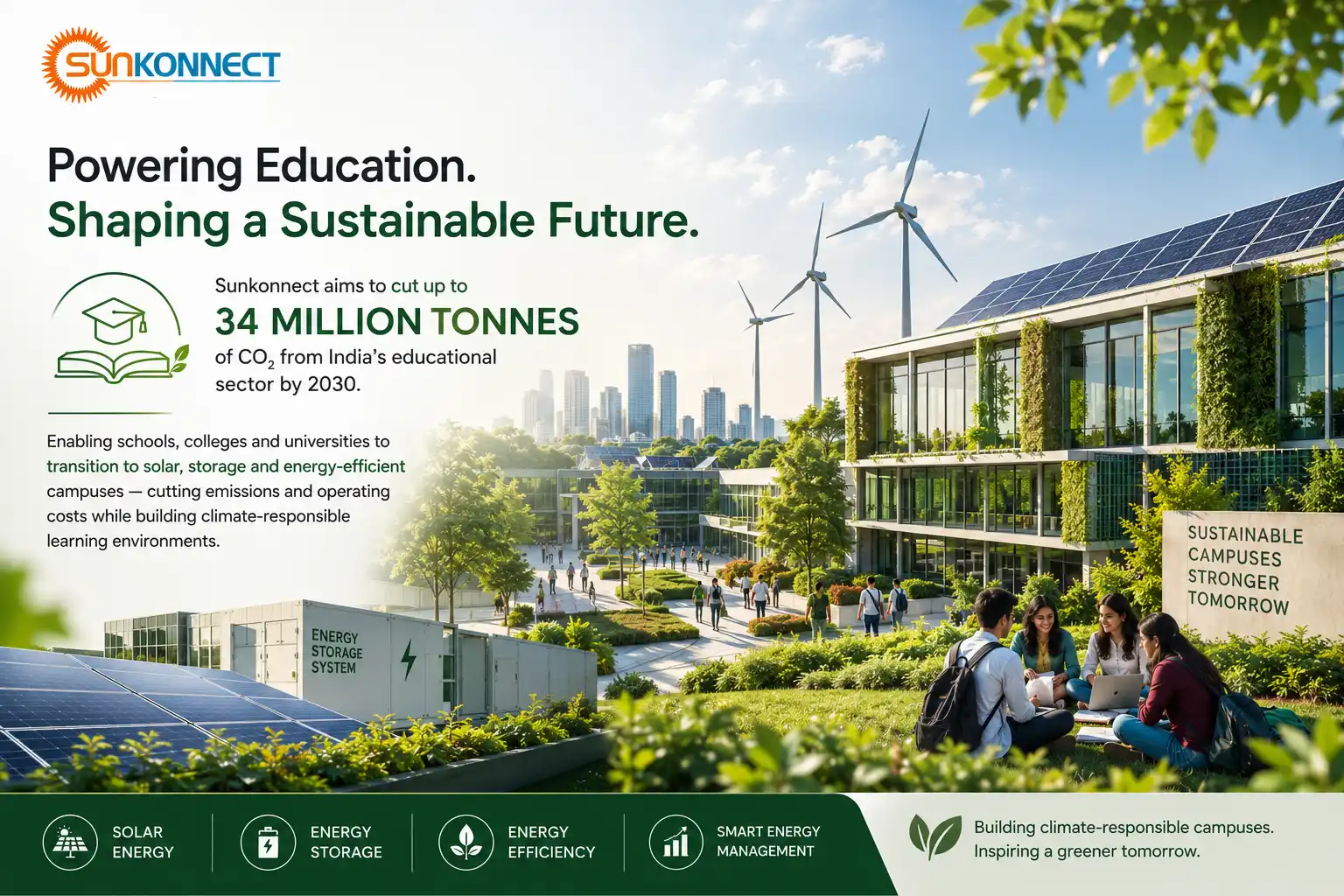
Educational institutions have an important role to play in shaping a sustainable future. Recognising this opportunity, Sunkonnect has announced its vision to help reduce up to 34 million tonnes of CO₂ emissions from India’s educational sector by 2030 through renewable energy adoption and sustainable campus development.
Schools, colleges, universities and educational campuses consume significant amounts of electricity every year. By integrating solar energy, energy-efficient infrastructure, battery energy storage systems and smart energy management solutions, these institutions can substantially reduce both carbon emissions and long-term operating costs.
Sunkonnect’s initiative focuses on enabling educational institutions to transition towards cleaner energy while building campuses that are environmentally responsible, economically efficient and future-ready.
New initiative helps schools, colleges and universities transition to solar, storage and energy-efficient campuses — cutting emissions and operating costs while building climate-responsible learning environments.
Beyond infrastructure improvements, the initiative supports institutions in developing long-term sustainability strategies, strengthening ESG commitments and creating learning environments that inspire future generations to embrace climate responsibility.
The vision aligns with India’s broader clean energy objectives while demonstrating how the education sector can become a catalyst for large-scale climate action.
Through strategic partnerships, technical expertise and end-to-end implementation capabilities, Sunkonnect aims to help educational institutions become active contributors to India’s transition towards a low-carbon economy.
Reducing up to 34 million tonnes of CO₂ emissions by 2030 is not only a measurable environmental target but also a commitment to creating healthier, smarter and more sustainable campuses across the country.